
Satay in Singapore: From Hawker Stalls to Party Platters
Few smells say "Singapore" like satay smoke drifting across a hawker centre at night. Skewers of marinated meat, grilled over charcoal and dipped in thick peanut sauce, have been a local favourite for generations, from the old Satay Club to today's office parties and birthday spreads. Here is a short story of satay in Singapore, and how to serve it well at home.
Where did satay come from?
Satay is widely believed to have started in Java, Indonesia, where street vendors grilled small pieces of spiced meat on bamboo skewers. Some food historians link it to the kebabs brought by Indian and Middle Eastern traders. From Java it spread across the region, and today Malaysia, Indonesia, Singapore and Thailand all have their own much-loved versions.
In Singapore, satay became a true hawker classic: Malay-style chicken, beef and mutton satay, Hainanese-style versions, and every stall with its own marinade and peanut sauce recipe.
The legendary Satay Club
Ask an older Singaporean about satay and they will likely mention the Satay Club. It reportedly began in the late 1940s on Hoi How Road, off Beach Road, and in 1970 moved to the Esplanade park near Queen Elizabeth Walk. For 25 years, families and friends gathered under the trees by the waterfront to eat satay late into the night.
The Satay Club closed in 1995 to make way for the Esplanade arts centre and road works. Some stallholders moved on to new spots, and the tradition lives on at places like Satay by the Bay and the famous evening "satay street" outside Lau Pa Sat.
What makes good satay
- A good marinade. Lemongrass, turmeric, shallots, garlic and spices give satay its yellow colour and fragrance.
- Proper grilling. The meat should be tender and juicy inside with a lightly charred, smoky outside.
- A rich peanut sauce. Thick, nutty, a little sweet and a little spicy, made for dipping.
- The sides. Ketupat (compressed rice cakes), fresh onion and cucumber cut the richness.
How to eat satay like a local
Dip, do not drizzle. Each person takes a stick, dunks it in the peanut sauce, and eats it straight off the skewer. Cut the ketupat into cubes and dip those too. A slice of raw onion or cucumber between sticks keeps the palate fresh. Leave the empty sticks in a pile on the plate, and at a hawker stall, that pile is how the bill used to be counted.
From hawker stall to party platter
Satay is now one of the easiest crowd-pleasers for parties at home or in the office. It is ready to eat, easy to share and loved by kids and adults alike. A few tips:
- How much to order: allow 3 to 5 sticks per guest when satay is a side dish, or 8 to 10 sticks per guest if it is one of the main dishes.
- Serve it fresh: satay is best within 2 hours of delivery. To eat it later, refrigerate it, then reheat until steaming hot all the way through, and reheat only once.
- Add the classic sides: slice fresh onion and cucumber to serve on the side.
Our Satay Set comes with 50 grilled chicken satay skewers, peanut sauce and ketupat, ready to serve with no grilling needed. It suits about 10 to 15 guests as a side. For prices, delivery and a quick party calculator, see our satay delivery page.
What goes well with satay
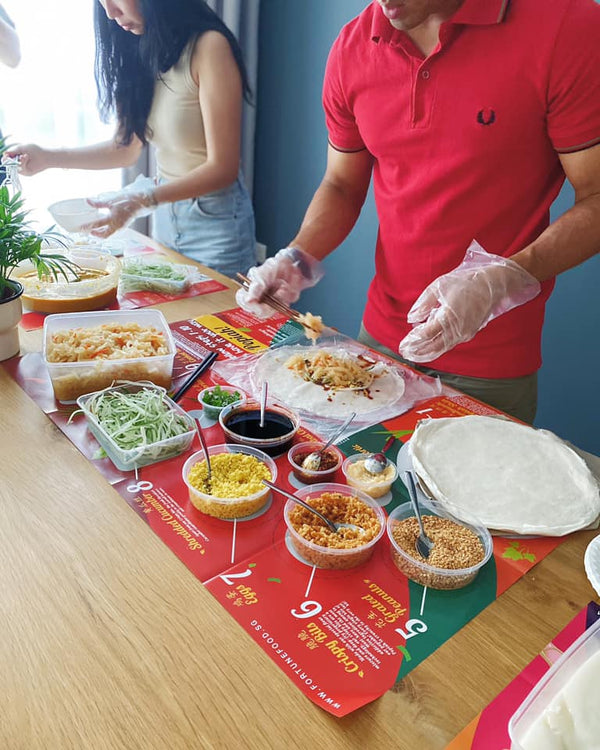
Pair satay with other local favourites for a complete party spread: a DIY popiah set, crispy Kueh Pie Tee, or a finger food platter. Feeding 20? The Fortune High Tea for 20 includes satay along with finger food, Kueh Pie Tee, rojak, muah chee and orh nee.
Satay FAQ
Where did satay originate?
Satay is widely believed to come from Java, Indonesia, and spread across Southeast Asia. Singapore, Malaysia, Indonesia and Thailand each have their own styles.
What was the Satay Club?
A famous open-air satay hawker centre that operated at the Esplanade park from 1970 until it closed in 1995. It began in the late 1940s near Beach Road.
How many satay sticks per person?
About 3 to 5 sticks per guest as a side dish, or 8 to 10 sticks if satay is one of the main dishes.
Is your satay halal?
Yes. Our Satay Set is halal and prepared in our MUIS Halal-certified central kitchen in Bedok.
What is ketupat?
Ketupat is rice compressed and cooked into a firm cake. It is cut into cubes and dipped into peanut sauce with satay.