
Peranakan Food: A Friendly Guide to Nyonya Dishes in Singapore
Ask a Singaporean about Peranakan food and you'll usually get a story before you get a recipe: a grandmother who pounded spice paste by hand, a festive table that took days to prepare, an argument over whose laksa was better. Peranakan cooking, also called Nyonya food, is one of the most distinctive parts of Singapore's food heritage. It's also one of the easiest to fall in love with. This guide covers what it is, the flavours that define it, a handful of dishes worth knowing, and a few relaxed ways to bring those flavours to your own dinner table.

What is Peranakan food?
"Peranakan" means "locally born". In Singapore it most often refers to the Peranakan Chinese, also called the Baba and Nyonya or the Straits Chinese. Their cuisine blends Chinese cooking techniques with Malay and Indonesian spices and ingredients. Culturepaedia describes it as "an early example of fusion food in the Malay Archipelago".
The name "Nyonya" (also spelled Nonya) comes from the Peranakan women, the Nonyas, who folded these influences into their home cooking over generations. That's why Nyonya food is so often talked about as home food: dishes with a family story attached, made the way someone's mother or grandmother made them.
The flavours that make it Nyonya
If you're tasting Peranakan food for the first time, a few flavours keep coming back:
- Rempah: a pounded spice paste that is the base of many dishes. For laksa, it typically includes laksa leaves, lemongrass, galangal, candlenuts, turmeric, shallots, chillies, garlic and belacan.
- Belacan: fermented shrimp paste, which gives sambals their deep, savoury punch.
- Coconut milk: Singapore's Peranakan cooking draws heavily on the Malay world, which is why so many dishes are rich with coconut, alongside robust sambals.
- Tamarind and lime leaf: sourness and fragrance that cut through the richness.
Put together, these give Nyonya food its signature layering: spicy, sour, savoury and a little sweet, often in the same mouthful.
Dishes worth knowing
Laksa lemak
The Singapore laksa most people know is rice noodles in a curry-based soup made with coconut milk, often called laksa lemak or curry laksa. Its origin in Singapore isn't certain, but the National Library notes it may be a Peranakan creation, given its mix of Chinese rice noodles and Malay spice paste. Want to know more? Start with the laksa set, cooked by our cook, or read about the dish in our local dishes guide.
Kueh pie tee
Crispy little pastry cups filled with a savoury braised filling and topped at the table. They're nicknamed "top hats" for their shape. Today kueh pie tee is known as a Peranakan dish, but its history is a puzzle. Cookbook author Christopher Tan traced early recipes under the name "kueh patty", and the earliest local mention he found of "pie tee" was in a 1954 newspaper report. Read our kueh pie tee story, or fill your own with a kueh pie tee set.
Popiah, Nyonya style
Popiah has Hokkien roots in Fujian province, and the Chinese diaspora has created many local versions, including a Nonya one. In Singapore, the sweet sauce brushed onto the skin is described as a Nonya addition. Popiah and kueh pie tee are close cousins: the same kind of filling, in a soft roll or a crisp cup. See our guide to popiah.
Mee siam
Rice vermicelli in a sweet-and-tart gravy. Its roots are argued over: some say Thai, some Malay, some Peranakan, and many writers now see it as a true fusion dish. It's a good example of how blurry and delicious the lines between Singapore's food cultures can be. Our mee siam vs mee soto guide compares it with its soupy neighbour.
Kueh and festive bakes
The National Library also notes that some Peranakan treats were inspired by goods from European traders, such as kueh lapis legit and pineapple tarts. Another reason the Peranakan table feels so festive.
How to enjoy Peranakan-style dishes at home
You don't need a three-day cooking marathon to enjoy these flavours.
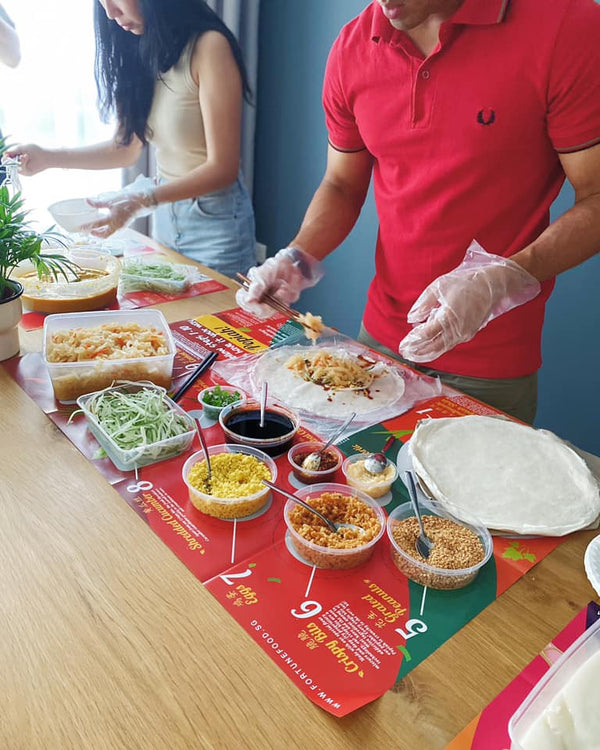
- Start with sharing dishes. Kueh pie tee and popiah are made for the middle of the table. Everyone fills or rolls their own, which turns dinner into something to do together. (For a big gathering, ready-rolled popiah rolls are an option, with a minimum order of 100 rolls. Order at least 48 hours ahead.)
- Add one soupy dish. A bowl of laksa ties the meal together and makes it feel complete.
- Balance the heat. Serve sambal on the side so younger guests and anyone who doesn't take chilli can join in.
- Fill at the last minute. Kueh pie tee shells stay crisp when you fill them just before eating.
- Bring the stories. Ask the oldest person at the table how their family made it. That's half the fun of Peranakan food.
A simple Nyonya-inspired spread for dinner
If you'd rather not cook, here's an easy way to put a Nyonya-inspired dinner on the table. To be clear, these are our versions of dishes found on Peranakan tables. We're not a Peranakan restaurant.
- Starter: a kueh pie tee set (Mini 30 pcs, Regular 50 pcs or Large 100 pcs) or a popiah party set
- Main: a laksa set, cooked by our cook. Small serves about 9 small bowls or 5 big bowls.
- For 4 to 8 people: a family dinner set lets you pick kueh pie tee or popiah plus a laksa main in one order.
Halal: our kueh pie tee, popiah and laksa sets are MUIS Halal. Our mee siam isn't halal. In our family dinner sets, everything is MUIS Halal except mee siam and mee soto.
Still deciding what to eat tonight? Our what to eat for dinner guide sorts it by situation.
Try a Nyonya-inspired dinner at home: Kueh Pie Tee Set · Laksa Set · Family Dinner Sets
Peranakan food FAQ
What is Peranakan food?
Peranakan food, also called Nyonya food, is the cuisine of the Peranakan Chinese in Singapore and the region. It blends Chinese cooking techniques with Malay and Indonesian spices and ingredients.
What's the difference between Peranakan and Nyonya food?
They're usually the same thing. "Nyonya" (or Nonya) refers to Peranakan women, who shaped the cuisine at home, so Peranakan cooking is often called Nyonya food.
What are some well-known Peranakan dishes?
Laksa lemak and kueh pie tee are among the best known. Mee siam is often linked to the Peranakans too, though its origins are debated.
What flavours are typical of Nyonya cooking?
Pounded spice paste (rempah), belacan, coconut milk, tamarind and fragrant leaves, often combining spicy, sour, savoury and sweet in one dish.
Is kueh pie tee Peranakan?
Kueh pie tee is known today as a Peranakan dish, but its exact origins are uncertain. Early recipes called it "kueh patty".
Sources
- NLB, Food Heritage (LearnX)
- Singapore Chinese Cultural Centre, Culturepaedia: Peranakan Chinese food in Singapore
- NLB Singapore Infopedia: Laksa
- BiblioAsia (NLB), Christopher Tan: Cups and Sources: Hunting Down the Origins of Kueh Pie Tee
- BiblioAsia podcast: Kueh Pie Tee: A Detective Story
- NLB Infopedia: Popiah (archived)
- Culturepaedia: Hokkien food in Singapore
- Roots.gov.sg (NHB): Popiah
- NLB Infopedia: Mee siam


