
Singapore Local Dishes: The Stories Behind the Food We Love
Every Singaporean has a dish that tastes like home. For some it's the laksa from the stall near their grandparents' flat. For others it's the popiah their aunties rolled at every family gathering, or the bowl of orh nee that only came out at celebrations. Our local dishes are a mix of cultures, borrowed names and family recipes, and most of them come with a story. Here are the stories behind some of our favourites, what makes each one, and how to bring a few of them to your dinner table.

Why local food tastes like home
Singapore's food grew out of many kitchens: Chinese, Malay, Indian, Peranakan and more. Dishes travelled, swapped ingredients and picked up new names along the way. That's why so many of our favourites are hard to pin to a single origin, and why arguments over the "real" version can last a whole dinner. If you want to dig deeper into one strand of that mix, read our Peranakan food guide.
What is laksa?
Laksa is a dish of rice noodles in a curry or hot soup. In Singapore, the gravy usually contains coconut milk, which is why it's often called Singapore laksa, laksa lemak or curry laksa.
The name itself has more than one possible story. Some believe it comes from the Hindi word lakshah, meaning "hundred thousand", for the many ingredients that go into it. Others trace it to a Persian word for vermicelli. The dish's origin in Singapore is uncertain too. It may be a Peranakan creation, bringing together Chinese rice noodles and a Malay spice paste.
What makes laksa is the spice paste, or rempah, built from laksa leaves, lemongrass, galangal, candlenuts, turmeric, shallots, chillies, garlic and belacan. Elsewhere in the region the dish changes completely: Penang's assam laksa, for example, is sour with tamarind.
Our laksa set is cooked by our cook and comes with bee hoon, sliced fish cake and prawn, taupok, shredded cucumber, sambal chilli and laksa leaves, portioned into small bowls for sharing.
Popiah: the roll you build yourself
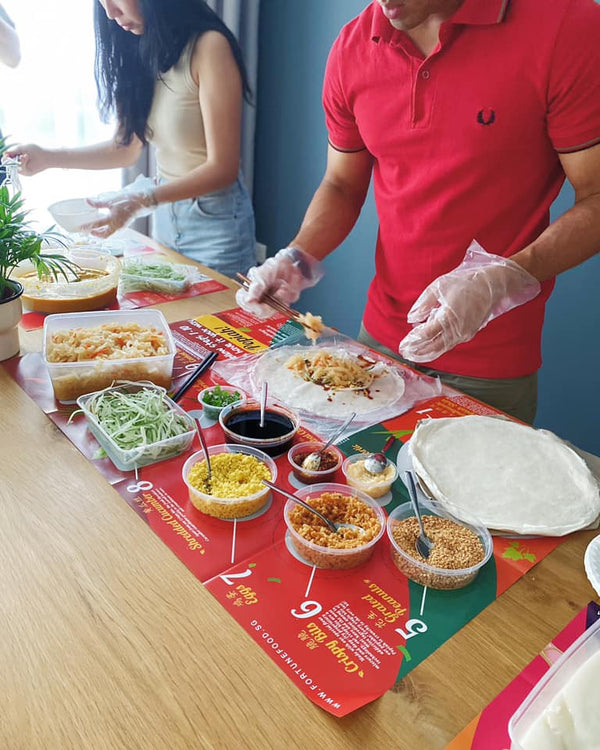
Popiah is a thin crepe wrapped around a cooked vegetable filling. Its name means "thin pancake" in Teochew, and in Hokkien it's also called lun pia, "elastic pancake". Its roots are in Fujian province, and in Singapore it's sold at hawker centres and is a favourite at do-it-yourself popiah parties, where everyone assembles their own.
The fun is in the rolling: a swipe of sweet sauce, a little chilli and garlic, a scoop of filling, then fold and roll. Our skins are soft and springy, made to be rolled at the table. Rather skip the rolling for a big event? Our ready-rolled popiah rolls come hand-rolled, with a minimum order of 100 rolls. Order at least 48 hours ahead. For the full story, read our guide to popiah or what's in a popiah.
Kueh pie tee: the mystery of the "top hats"
Crispy pastry cups filled with a savoury braised filling, kueh pie tee got the nickname "top hats" from their shape. "Pie tee" doesn't mean anything in any local dialect, which made cookbook author Christopher Tan curious. He found that early recipes and newspapers called it "kueh patty", and the earliest local mention he found of "pie tee" was a 1954 newspaper report of a church food fair.
Today it's known as a Peranakan dish and a staple of family parties. The trick is to fill each cup just before eating so it stays crisp. Read the full story in what is kueh pie tee, or fill your own with a kueh pie tee set.
Mee siam and mee soto: two noodle bowls, two moods
Mee siam is bee hoon (rice vermicelli) in a sweet-and-tart gravy. Its name is Malay for "Thai noodles", and the earliest local newspaper mention found by the National Library dates to 1950, when hawkers sold it at the Esplanade. Whether it's Thai-inspired, Malay or Peranakan is still debated, and many writers see it as a blend of all of them.

Mee soto is noodles in a spiced soup topped with shredded chicken. Ours comes with the chilli on the side, so it's an easy pick for anyone who doesn't take spice.
Which one fits your night? Our mee siam vs mee soto guide compares them. Note: our mee siam and mee soto aren't halal.
Satay, XO glutinous rice and the dishes that fill a table
Some dishes exist to be shared. Satay, grilled skewers with peanut sauce and ketupat, disappears fast from any table; read more in satay in Singapore. XO glutinous rice, glutinous rice mixed with dried shrimp and mushrooms, is the kind of filling main that's easy to scoop onto every plate. Neither needs a special occasion, but both make an ordinary dinner feel like one.


Something sweet: orh nee and muah chee
Orh nee is a Teochew yam paste dessert, often served at celebrations. Our version comes with coconut sauce, shallot oil and ginkgo nuts packed separately so you can finish each bowl at the table. Read what is orh nee.
Muah chee is glutinous rice dough coated in ground peanuts and sugar. Read what is muah chee.
Both make the kind of ending that gets someone at the table saying, "Last time ah…"
Bringing local dishes to your dinner table
You don't need to queue at five stalls to enjoy these at home.
- Mix textures: something to roll or fill (popiah, kueh pie tee), something soupy (laksa), something to share (satay).
- Keep chilli on the side so kids and elders can join in.
- Assemble at the table. Half the fun of local food is building your own.
- Plan ahead. Our Family Dinner Set, 2 Courses is ordered by 5pm for next-day delivery, or by 8pm for next-day self-collection. The 3- and 4-course sets need 48 hours. For a smaller table, the Mini Feast for 5 (mini popiah, mini laksa, mini muah chee and kueh pie tee shells) is ordered by 5pm the day before for delivery, or by 8pm the day before for self-collection.
Halal: our laksa, popiah (sets and rolls), kueh pie tee, satay, XO glutinous rice, orh nee and muah chee are MUIS Halal, and so is the Mini Feast for 5. Our mee siam and mee soto aren't halal.
Not sure which to pick tonight? Our what to eat for dinner guide sorts it by situation.
Put a local spread on your table: Family Dinner Sets · Mini Feast for 5 · Laksa Set
Singapore local dishes FAQ
What is laksa?
Laksa is a dish of rice noodles in a curry or hot soup. In Singapore it's usually made with a coconut-milk gravy, so it's also called laksa lemak or curry laksa.
Where does the name "laksa" come from?
No one is sure. Suggestions include the Hindi word lakshah ("hundred thousand") and a Persian word for vermicelli.
Why is kueh pie tee called "top hats"?
Because the crispy cups look like little top hats. Early recipes called the dish "kueh patty".
What does "mee siam" mean?
It's Malay for "Thai noodles". Its origin is debated: some say it's Thai-inspired, while others credit Malay or Peranakan cooks.
Which Singapore local dishes are good for a family dinner?
Shareable dishes work best: popiah or kueh pie tee to start, laksa or XO glutinous rice as a main, satay on the side, and orh nee or muah chee to finish.


